
Use it directly
- CSV and JSON exports
- Airtable or spreadsheet delivery
- Database and warehouse-ready records
- Customer-controlled backups
Know when competitor prices, availability, sellers, variants, or product ranges change across approved public retail and marketplace pages.
Your input
You do not need to prepare technical configuration. Provide the business requirements, examples, and approved access; we translate them into fields, rules, and a tested schedule.
The result
A source-backed commercial change register that helps pricing, merchandising, procurement, category, and market teams investigate price gaps, stock movements, new products, and seller changes before acting.
Best for: Pricing, revenue-management, merchandising, category, procurement, e-commerce, brand, product, marketplace, retail-operations, and competitive-intelligence teams with an approved product or category watchlist.
AI-ready delivery
Receive normalized records directly or let an approved agent retrieve them through a scoped interface. Source evidence, transformations, timestamps, and exception states remain available for review.
Explore managed services for outreach and follow-upConfigurable service
The modules describe business capabilities, not separate tools to operate. Select the coverage, filters, review rules, schedule, and destination during setup.
Worked example
Examples show the delivery structure before setup. Names and values are illustrative, not client records or performance claims.
Example input
{
  "product_watchlist": [
    {
      "customer_sku": "SYN-HEADPHONE-01",
      "brand": "Example Audio",
      "model": "X100",
      "urls": [
        "https://retailer.example/products/x100",
        "https://marketplace.example/item/x100"
      ]
    }
  ],
  "category_urls": [],
  "markets": [
    "US"
  ],
  "fields": [
    "price",
    "currency",
    "availability",
    "shipping",
    "seller",
    "variants",
    "rating",
    "review_count"
  ],
  "normalization": {
    "compare_same_variant_only": true,
    "include_shipping": true,
    "currency": "USD"
  },
  "frequency": "Daily",
  "expected_records_per_run": 20,
  "delivery": "Competitive price review table"
}
Example delivery
Illustrative record{
"customer_sku": "SYN-HEADPHONE-01",
"match_status": "matched_reviewed",
"source": "retailer.example",
"source_url": "https://retailer.example/products/x100",
"market": "US",
"product_name_raw": "Example Audio X100 Wireless Headphones",
"variant_raw": "Black",
"price_raw": "$279.00",
"currency_raw": "USD",
"shipping_raw": "Free",
"normalized_comparable_price": 279,
"previous_comparable_price": 299,
"price_change_percent": -6.69,
"availability_raw": "In stock",
"seller_raw": "Example Retailer",
"collected_at": "2026-08-19T09:00:00Z",
"review_state": "price_drop",
"example_status": "synthetic"
}Installation path
The first representative run is reviewed before the workflow becomes a recurring operation.
Define the business decisions, approved sites, products, categories, markets, fields, and monitoring thresholds
Run a representative sample across each selected site or input type
Review source coverage, product matching, variant handling, currency, shipping, tax, missing fields, duplicates, and exceptions
Confirm normalized measures, alert rules, record volume, schedule, and destination
Launch the agreed monitoring cycle
Review price, stock, seller, assortment, source-layout, and cost-driving volume changes
Managed history
Each run can append timestamped observations instead of replacing prior values. Price, currency, shipping, stock, seller, variant, assortment, rating, review-count, match, availability, and exception states can be compared by product, source, market, and time.
Retention and portability
Retention is agreed during setup. Structured observations can be exported to CSV, JSON, spreadsheets, a database, warehouse, or another customer-controlled destination. Product images, page captures, review text, seller records, and long-term archives require explicit purpose, rights, storage, and retention terms. Deletion and portability requirements are scoped explicitly. The resulting dataset belongs to the customer. Aineed Data retains only the managed copy and history agreed for operation. CSV, JSON, Airtable, database, warehouse, scoped API, customer-controlled backup, deletion, portability, and exit-export requirements are defined during setup.
Interpretation limits
History makes comparison possible, but it does not remove source limitations or turn signals into guaranteed business outcomes.
Results are timestamped public observations, not a complete, real-time, or official retailer feed
Prices, availability, sellers, shipping, tax, promotions, ratings, and reviews can vary by location, account state, fulfilment method, currency, device, experiment, and collection time
Product names and images alone may not establish that two listings are the same item
Pack size, variant, seller, condition, subscription, coupon, member price, tax, and shipping differences can make direct price comparison misleading
Currency conversion, unit price, landed cost, and comparison fields depend on documented assumptions
Historical data begins when scheduled collection starts; the workflow does not create prior observations
Some sites, pages, fields, or layouts may be unavailable, incomplete, unstable, or unsupported
Ratings and reviews do not prove product quality, demand, authenticity, or customer sentiment
Scaling price depends on sites, markets, pages, products, sellers, reviews, returned records, frequency, storage, and review requirements
Customers remain responsible for lawful purpose, source terms, intellectual property, pricing decisions, marketplace rules, and downstream use
Safeguards
Access, retention, exports, and operating controls are confirmed for this workflow before launch.
Publicly accessible product, category, seller, and review information only
No attempt to access authenticated, private, account-restricted, or prohibited content
Source URL, market, currency, and collection timestamp retained
Raw published values remain separate from normalized prices, converted currencies, landed-cost assumptions, and calculated differences
No autonomous price changes, purchasing, seller enforcement, outreach, or commercial commitments
Product matching and material commercial changes retain review states
Review authors and text are included only when required for the approved purpose and retention policy
No representation of retailer, marketplace, brand, or platform affiliation, endorsement, official feed status, or complete coverage
Related workflows
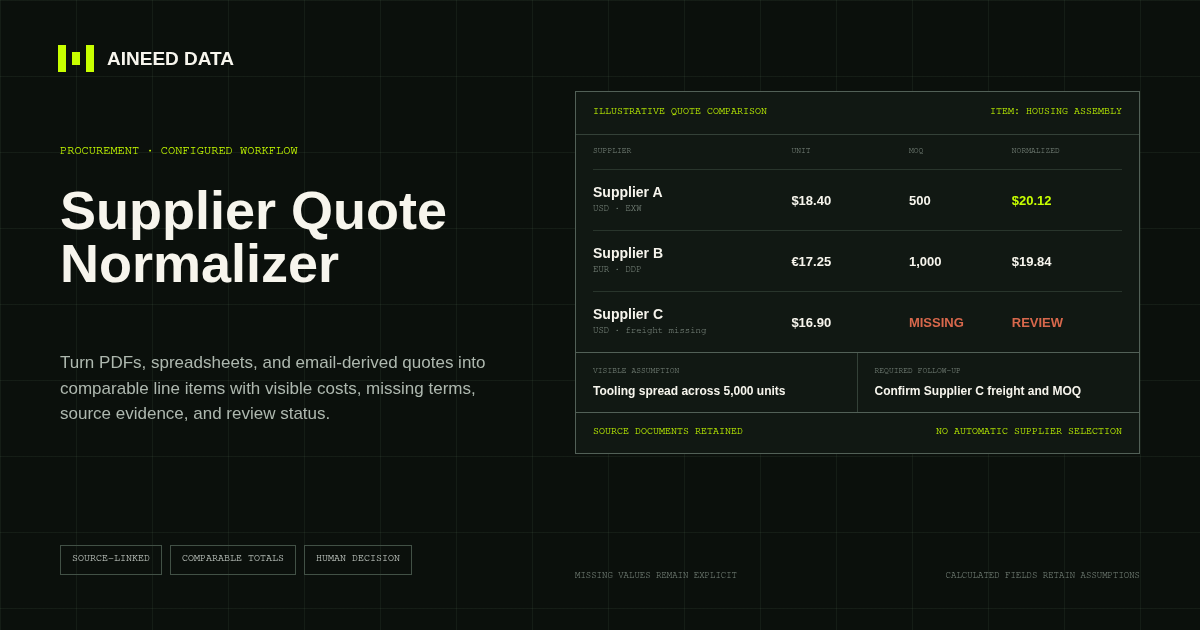
Data Collection · Configured
Convert supplier quotes from PDFs, spreadsheets, and approved email-derived text into comparable line items with explicit terms, assumptions, source evidence, and missing-information flags.
Explore workflow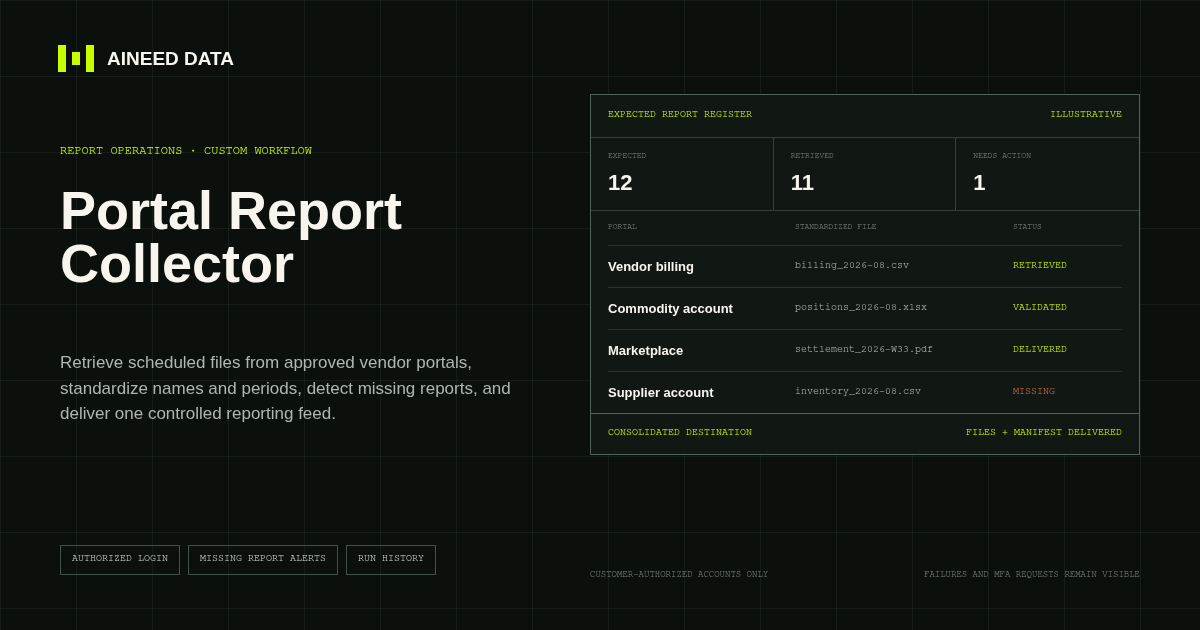
Reporting · Custom
Sign in to approved vendor and business portals on schedule, retrieve expected CSV, Excel, PDF, and other report files, and deliver one validated reporting feed.
Explore workflow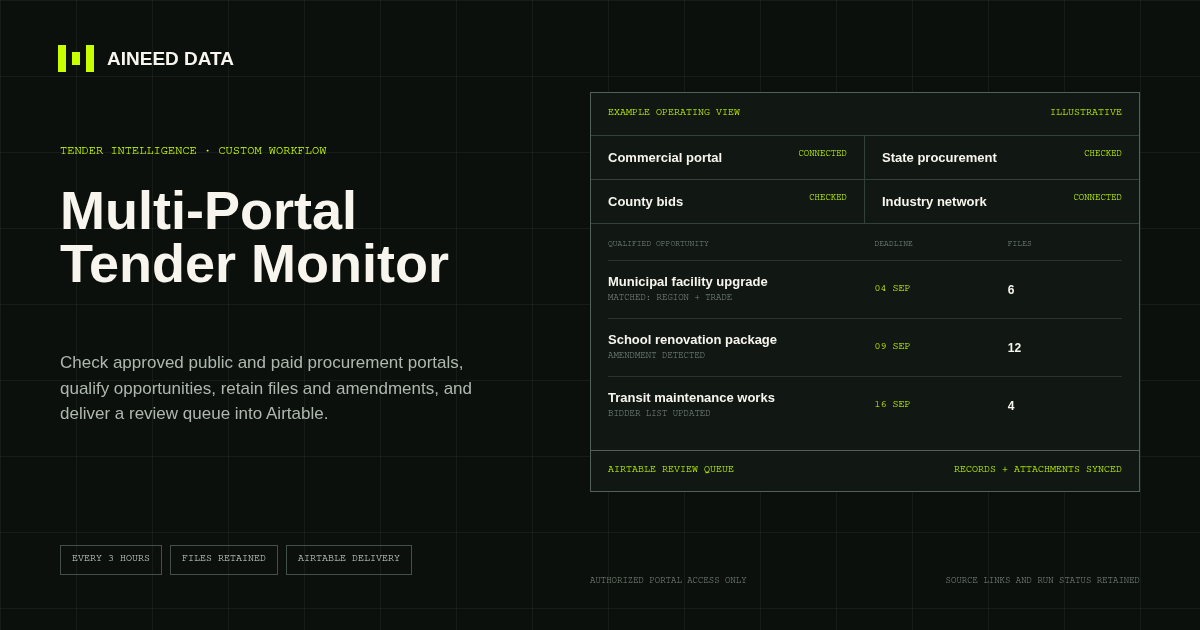
Monitoring · Custom
Monitor an agreed mix of public and customer-authorized paid tender portals, apply qualification rules, track changes, and deliver source-linked opportunities and files into Airtable.
Explore workflow
Start setup
Share the sources, rules, and destination. We’ll verify access and confirm the final setup and monthly operating scope.