
Use it directly
- CSV and JSON exports
- Airtable or spreadsheet delivery
- Database and warehouse-ready records
- Customer-controlled backups
Turn approved topics, queries, countries, and languages into a recurring feed of publisher-linked news evidence with clean text and explicit retrieval states.
Your input
You do not need to prepare technical configuration. Provide the business requirements, examples, and approved access; we translate them into fields, rules, and a tested schedule.
The result
A current, source-linked evidence layer that analysts and AI agents can search, retrieve, summarize, compare, and cite without relying on untraceable article snippets.
Best for: Strategy, communications, market research, policy, risk, product, investment, competitive-intelligence, and knowledge teams following defined news topics.
AI-ready delivery
Receive normalized records directly or let an approved agent retrieve them through a scoped interface. Source evidence, transformations, timestamps, and exception states remain available for review.
Explore managed services for outreach and follow-upConfigurable service
The modules describe business capabilities, not separate tools to operate. Select the coverage, filters, review rules, schedule, and destination during setup.
Worked example
Examples show the delivery structure before setup. Names and values are illustrative, not client records or performance claims.
Example input
{
  "queries": [
    "industrial heat pump investment",
    "EU industrial decarbonisation policy"
  ],
  "countries_and_languages": [
    "US:en",
    "DE:de"
  ],
  "days_back": 7,
  "max_publishers_per_edition": 20,
  "required_fields": [
    "headline",
    "publisher",
    "published_at",
    "clean_text",
    "source_url"
  ],
  "ai_uses": [
    "Cited daily brief",
    "Entity retrieval"
  ],
  "frequency": "Daily",
  "delivery": [
    "JSON",
    "Scoped API"
  ]
}
Example delivery
Illustrative record{
"headline": "Synthetic industrial investment announcement",
"publisher": "Example Business News",
"source_url": "https://www.example-news.test/articles/synthetic-investment",
"published_at_raw": "2026-08-18",
"query": "industrial heat pump investment",
"language": "en",
"country_edition": "US",
"evidence_excerpt": "Synthetic example text for workflow review.",
"citation_key": "news-2026-08-19-001",
"collected_at": "2026-08-19T09:00:00Z",
"retrieval_state": "complete",
"review_status": "human_review",
"example_status": "synthetic"
}Installation path
The first representative run is reviewed before the workflow becomes a recurring operation.
Confirm approved topics or queries, countries, languages, publishers, date window, exclusions, evidence fields, and intended AI uses
Run a representative sample and inspect relevance, duplication, publication dates, language, article access, extraction quality, and failure states
Agree source allowlists, citation keys, text retention, deduplication, entity extraction, human review, cadence, and destination
Discover articles and retrieve approved public publisher pages within documented boundaries
Preserve publisher text and metadata separately from summaries, classifications, embeddings, and AI-assisted extraction
Deliver complete, partial, paywalled, blocked, unavailable, duplicate, and review-required states separately
Managed history
Recurring runs append timestamped article discovery and retrieval observations so new, changed, duplicated, unavailable, or conflicting evidence remains comparable over time.
Retention and portability
The resulting dataset belongs to the customer. Delivery can be made as CSV, JSON, Airtable, Markdown, a database, vector-ready records, webhook, or scoped API. Aineed Data retains only the managed copy and history agreed for operation. Full text, excerpts, embeddings, backups, deletion, portability, and exit exports follow publisher rights and the engagement scope.
Interpretation limits
History makes comparison possible, but it does not remove source limitations or turn signals into guaranteed business outcomes.
Discovery feeds and publisher pages are not exhaustive and vary by query, edition, language, ranking, and time
Publisher dates, headlines, snippets, canonical URLs, and article text can be missing, changed, syndicated, or inconsistent
Some pages are paywalled, blocked, inaccessible, script-dependent, or only partially retrievable
Clean text can include navigation, captions, updates, or unrelated page elements
A published article or repeated claim does not establish truth, independence, authority, or completeness
AI summaries, entity extraction, classification, and embeddings can omit context or introduce errors
Licensing and retention can limit storage of full article text
The feed is scheduled, not guaranteed real-time, and service targets are agreed separately
Safeguards
Access, retention, exports, and operating controls are confirmed for this workflow before launch.
Approved public news sources and documented research purpose only
No credentials, subscription sessions, cookies, tokens, MFA codes, or paywall access requested
No bypassing paywalls, access controls, publisher restrictions, licensing, robots rules, or request limits
Article text, metadata, excerpts, summaries, and embeddings remain distinguishable
Every generated finding can retain a publisher URL, citation key, and collection timestamp
Conflicting, weak, stale, or single-source claims are flagged for human review
No autonomous publication, trading, legal, medical, security, or other consequential action
No claim of exhaustive news coverage, real-time delivery, publisher endorsement, or factual verification
Related workflows
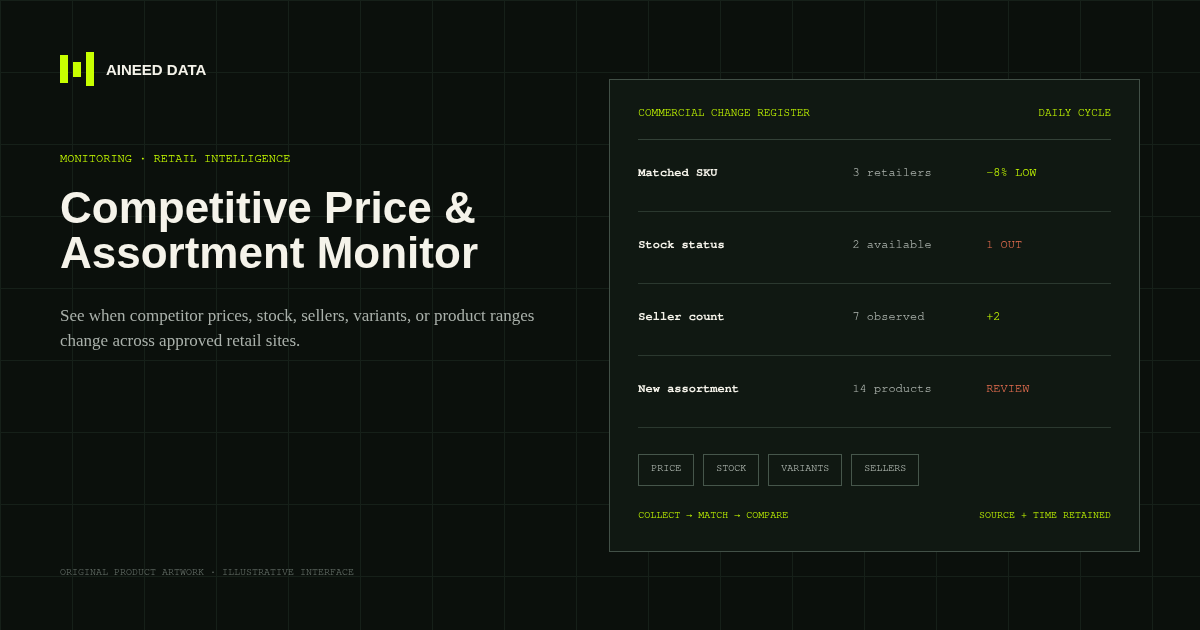
Monitoring · Configured
Know when competitor prices, availability, sellers, variants, or product ranges change across approved public retail and marketplace pages.
Explore workflow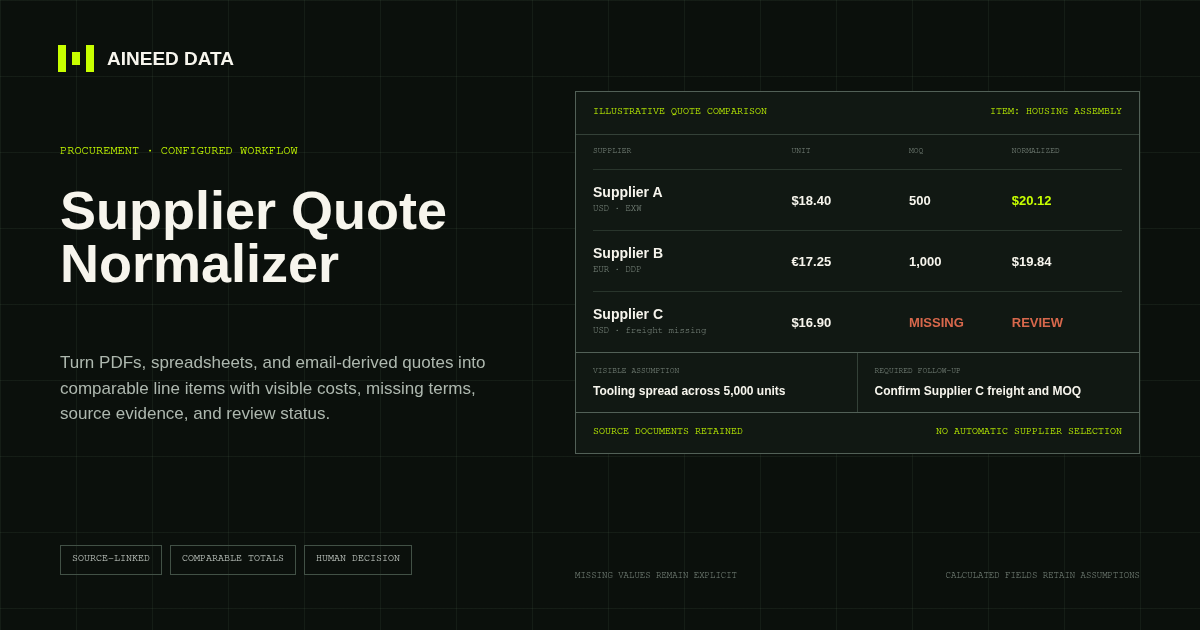
Data Collection · Configured
Convert supplier quotes from PDFs, spreadsheets, and approved email-derived text into comparable line items with explicit terms, assumptions, source evidence, and missing-information flags.
Explore workflow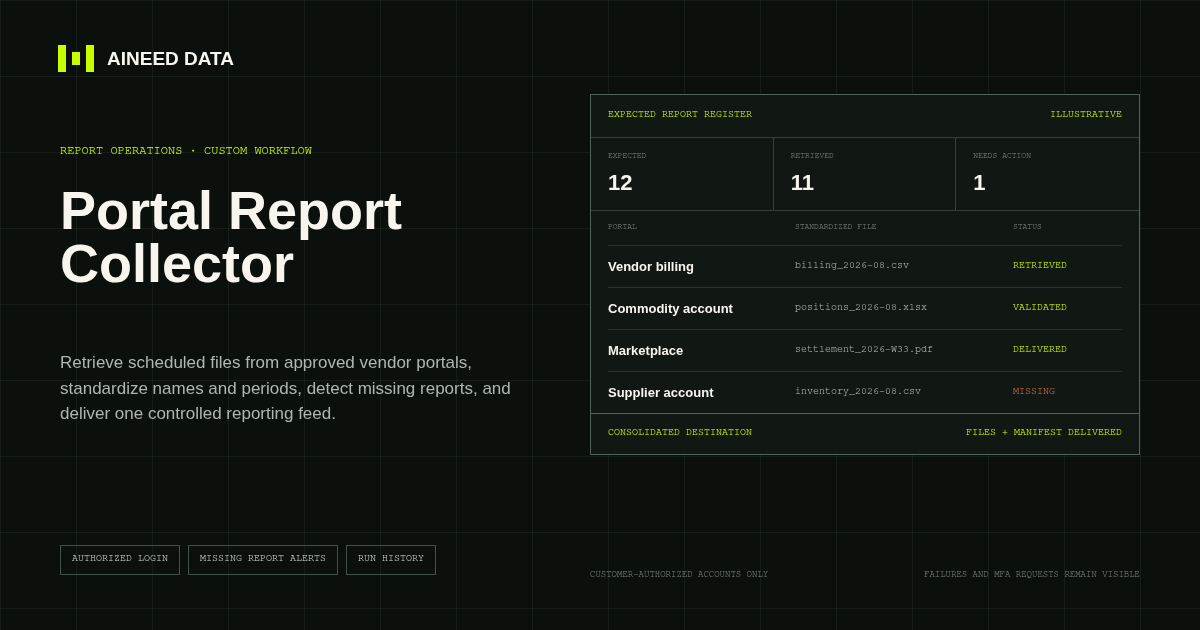
Reporting · Custom
Sign in to approved vendor and business portals on schedule, retrieve expected CSV, Excel, PDF, and other report files, and deliver one validated reporting feed.
Explore workflow
Start setup
Share the sources, rules, and destination. We’ll verify access and confirm the final setup and monthly operating scope.