
Use it directly
- CSV and JSON exports
- Airtable or spreadsheet delivery
- Database and warehouse-ready records
- Customer-controlled backups
Turn approved job searches and public listings into a normalized feed of roles, employers, locations, salary signals, requirements, benefits, and application routes.
Your input
You do not need to prepare technical configuration. Provide the business requirements, examples, and approved access; we translate them into fields, rules, and a tested schedule.
The result
A source-linked labor-market dataset that teams and AI agents can retrieve, compare, summarize, and route into approved research, workforce-planning, or recruiting workflows.
Best for: People analytics, workforce strategy, recruiting operations, compensation research, economic research, location strategy, education planning, and market-intelligence teams.
AI-ready delivery
Receive normalized records directly or let an approved agent retrieve them through a scoped interface. Source evidence, transformations, timestamps, and exception states remain available for review.
Explore managed services for outreach and follow-upConfigurable service
The modules describe business capabilities, not separate tools to operate. Select the coverage, filters, review rules, schedule, and destination during setup.
Worked example
Examples show the delivery structure before setup. Names and values are illustrative, not client records or performance claims.
Example input
{
  "searches": [
    {
      "role": "Data Analyst",
      "location": "Chicago, IL",
      "radius_miles": 25
    },
    {
      "role": "Backend Engineer",
      "location": "Dublin, Ireland",
      "remote": true
    }
  ],
  "max_results_per_search": 200,
  "date_window_days": 14,
  "required_fields": [
    "title",
    "employer",
    "location",
    "salary",
    "description",
    "application_url"
  ],
  "normalize_roles": true,
  "frequency": "Weekly",
  "delivery": [
    "Airtable",
    "Scoped API"
  ]
}
Example delivery
Illustrative record{
"job_title_raw": "Senior Data Analyst",
"role_family_normalized": "Data Analytics",
"employer": "Example Research Group",
"location_raw": "Chicago, IL",
"workplace_type_normalized": "Hybrid",
"salary_raw": "$95,000-$120,000 yearly",
"salary_min_annual_calculated": 95000,
"salary_max_annual_calculated": 120000,
"salary_source": "Employer displayed",
"source_url": "https://www.example-job-board.test/jobs/synthetic-101",
"first_observed_at": "2026-08-19T09:00:00Z",
"record_state": "complete",
"example_status": "synthetic"
}Installation path
The first representative run is reviewed before the workflow becomes a recurring operation.
Confirm approved roles, employers, locations, filters, fields, intended decisions, and prohibited employment uses
Run a representative sample and inspect duplicates, salary labels, location quality, application routes, descriptions, and missing states
Agree role, location, salary, employer, and workplace normalization rules plus retention and delivery
Collect approved public listings within documented source and request boundaries
Append timestamped observations and preserve raw fields separately from normalization and AI-assisted extraction
Deliver complete, duplicate, closed, stale, unavailable, partial, and review-required records separately
Managed history
Recurring runs append timestamped job observations so newly observed, changed, duplicated, closed, stale, or unavailable listings can be compared without overwriting prior states.
Retention and portability
The resulting dataset belongs to the customer. Delivery can be made as CSV, JSON, Airtable, spreadsheets, a database, warehouse, webhook, or scoped API. Aineed Data retains only the managed copy and history agreed for operation. Customer-controlled backups, snapshot frequency, portability, deletion, and exit exports are defined during setup.
Interpretation limits
History makes comparison possible, but it does not remove source limitations or turn signals into guaranteed business outcomes.
Job listings can be sponsored, duplicated, stale, estimated, removed, syndicated, or linked through third parties
Posting age, salary, benefits, remote status, location, application routes, and employer details can be missing or source-controlled
A visible listing does not prove active hiring, budget, headcount growth, employer identity, or application availability
Salary comparisons depend on pay period, currency, location, experience, commission, benefits, and source methodology
AI-assisted skill extraction and role normalization can omit context or misclassify requirements
Coverage varies by query, location, date window, source ranking, and collection time
Pages can be blocked, unavailable, rate-limited, or changed after collection
Preferred-candidate fields can reflect discriminatory or unlawful criteria and are excluded from automated decision use
Safeguards
Access, retention, exports, and operating controls are confirmed for this workflow before launch.
Public job and employer sources only; no candidate accounts, resumes, credentials, or private applicant data
No passwords, cookies, tokens, MFA codes, private keys, or session exports requested
No bypassing access controls, publisher restrictions, geographic controls, licensing, or request limits
Personal employer contacts and inferred email patterns are excluded; role-based contacts require separate approval
No automated applications, candidate ranking, hiring, compensation, employment, or immigration decisions
Salary estimates remain labeled by source, pay period, location, and displayed versus calculated status
No claim that a posting is active, genuine, complete, employer-authored, or still accepting applications
No job-board affiliation, endorsement, official API access, exhaustive coverage, or guaranteed freshness
Preferred gender, nationality, and residence fields are excluded from AI matching, candidate ranking, and employment decisions
Related workflows
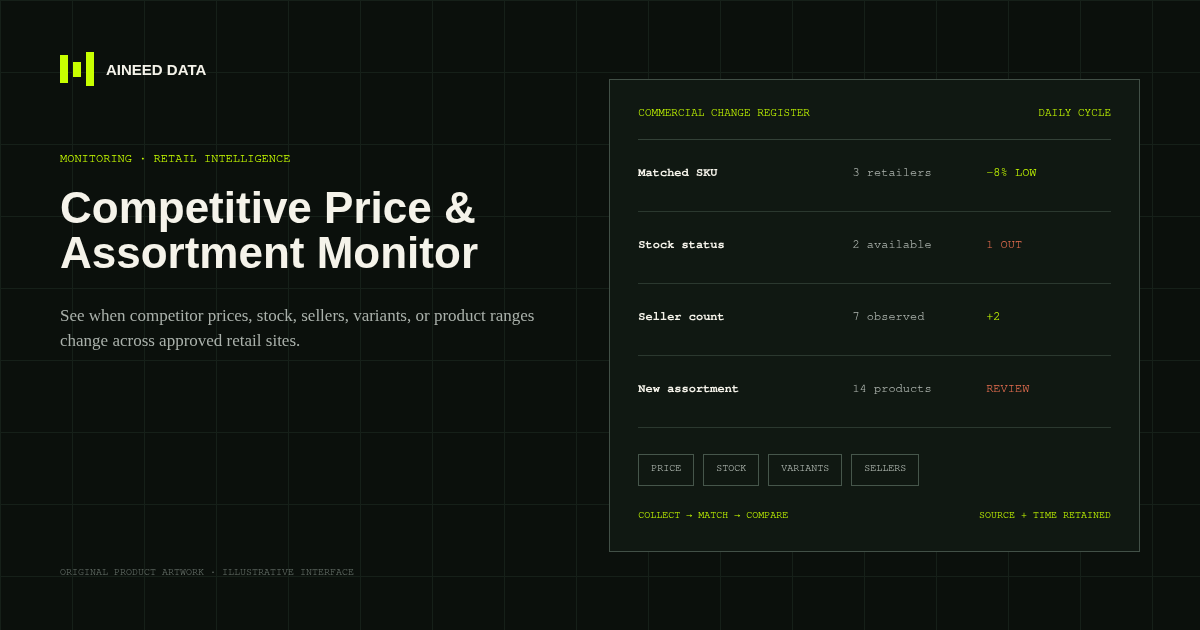
Monitoring · Configured
Know when competitor prices, availability, sellers, variants, or product ranges change across approved public retail and marketplace pages.
Explore workflow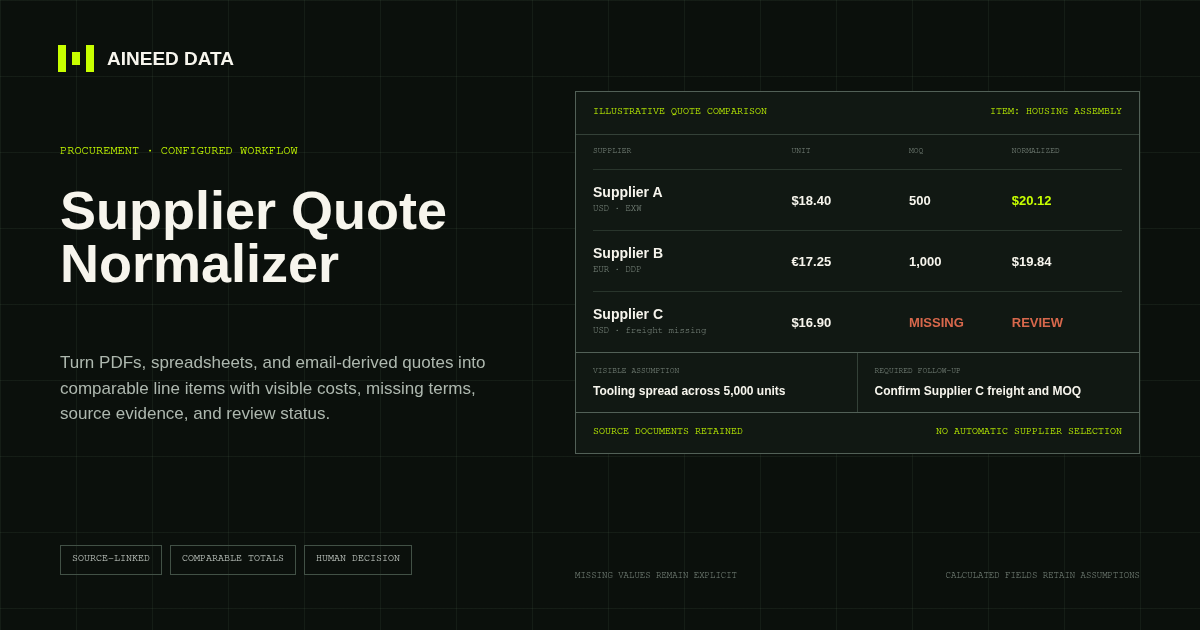
Data Collection · Configured
Convert supplier quotes from PDFs, spreadsheets, and approved email-derived text into comparable line items with explicit terms, assumptions, source evidence, and missing-information flags.
Explore workflow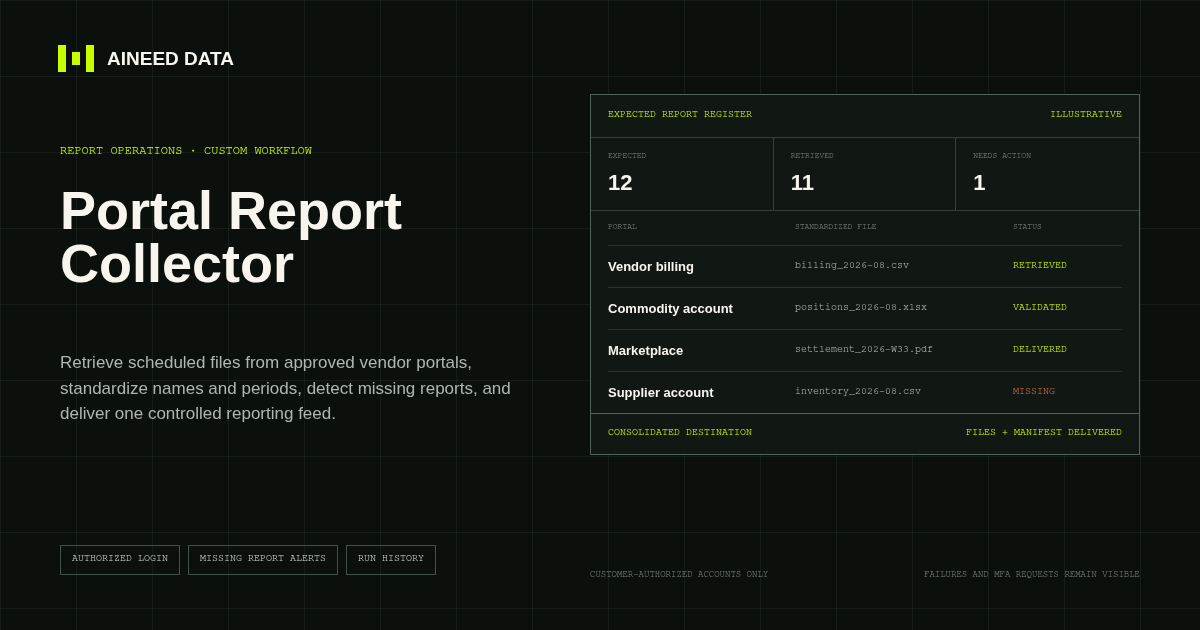
Reporting · Custom
Sign in to approved vendor and business portals on schedule, retrieve expected CSV, Excel, PDF, and other report files, and deliver one validated reporting feed.
Explore workflow
Start setup
Share the sources, rules, and destination. We’ll verify access and confirm the final setup and monthly operating scope.